Making, Not Finding, Time to Practice

practicetime-smAlmost all musicians struggle with finding enough time to practice. We can have the most determined and productivity-maximizing mindset, but if we fail at finding or making the time we need to properly develop our skills, we will be left dreaming of things that we can never do. For most of the aspiring virtuosi out there, technique development and “chops building” is what takes the lion’s share of their time. It takes years even decades, in some cases, to develop the world class abilities that we all dream of. We’ve all heard the tales of how our musical heroes spent their youth locked in their bedrooms grinding away at licks and scales. Finally, after years of metronomic torture, they emerged all powerful, ready to rule the stage. Facing the limitations of your own abilities can often times be an inspiration killer. “I can hear it in my head, but I can’t play it”, is the lamentation of so many players starting out. An “ear” for music can be partially achieved simply through the act of listening and paying attention, but when it comes to your playing ability, you have to put in hours upon hours of focused practice. To throw salt on your raw fingertips, many of the common exercises for developing fundamental skills are some of the most boring to play. You have to pay close attention to something that’s really boring, and you have to do it, for a long time… and then do it again and again and again. Are you encouraged yet? Those unpleasant realities aside, simply finding a chunk of your time that you can dedicate to future rock-stardom or even the most basic self improvement can be a monumental task. To many folks today, the idea of “free time” is laughable. The list of distractions available to us is growing ever longer and we are simultaneously expected to be more productive and more aware of the world around us.

Speaking of distractions…social media has become both a huge arsenal of networking tools and a huge time wasting machine for musicians. It’s worth taking a few sentences to talk about the important of budgeting your time on social media. Yes, it’s true that it’s helpful for musician’s to stay up on the current trends and certainly a lot of lyricists and songwriters find inspiration in the world’s current events. All that aside, the ability of social media to provide an endless stream of distraction is unrivaled. The easiest way to balance and manage the time you spend on social media is to simply schedule a block of time in your day specifically for social media. You can even set an alarm, and then another alarm to tell when your time is up. Yes, it might seem like micromanaging your own life, but considering how valuable our time becomes when we’re dedicating ourselves to developing our musical abilities, it’s a small price to pay for yet another advantage in the game of time management.

So, we’ve established that we need time to practice and that there are a lot of distractions. Yes, two paragraphs in and I’ve only told you things that you already know. No doubt you’d like hear something new. Let’s take a different approach to this. Rather than look for holes in your schedule that you can fill with practice time, let’s instead focus on restructuring what we do, and how we do it, and find ways to be more efficient, thereby creating time that we didn’t have before while maintaining the same level, or more, of productivity. Sounds easy right? Yeah, I don’t think so either. But let’s take a closer look.

First off, look at your schedule and identify the things that you absolutely have to get done. Things like your job or school or maybe taking care of your kids. We need to recognize that there are certain things that you just can’t realistically mess with and they should remain high on your priority list. That being said, almost everyone has times during the day when they’re watching TV, surfing the web, reading a magazine, masturbating, something like that. It’s at activities like those that you need to take a long, hard look, and ask yourself how important those things really are to you. Ask the question, if you had to choose between watching your favorite TV show or putting in the time necessary to become a great musician… which would you choose? It can be hard to see it in that light since watching TV gives you an instant result and practicing does not, but in the end they both accomplish something. What each one of those activities accomplishes is completely different and I would imagine that most people reading this would choose becoming a great musician over watching TV. Success is just a matter of making that same decision over and over again.

Now, let’s say that you have a uniquely packed schedule and you don’t actually have any time when you just sit down and watch a show or get lost on Facebook. Inhabitants of that situation might think that finding the time to practice would simply be impossible. No such luck. What it really means is that you just have to get more creative and more resourceful. So you’re working an 8 hour shift…. do you get a lunch? Maybe a couple of 15 minute breaks? Most people, if they have prepared a lunch ahead of time, can eat in 10 minutes. That leaves you 20 minutes to go outside or in your car and practice. That’s right, you’ll have to bring an instrument with you, but like I said, we’re trying to maximize resourcefulness here. Be “That Guy” who brings the guitar to work. What matters more… making progress or not standing out? In music standing out is a good thing. It’s a win win.

When it comthrough-the-eyes3-sized-smalles down to it, you have to take a serious, emotionless look at how you have prioritized your time and ask yourself if that’s really what’s best for you to reach your goals. And yes, “live for today because tomorrow may never come”… I get it. Let’s be honest though, tomorrow most likely will come and if you want it to be better than today, then you have to make the best decisions you can in the moment right now.

– Max Carlisle


Focus on Metal “Metal of Oz” Compilation, Featuring Maxxxwell Carlisle and more…

metalofozONLINE METAL PROMO, FOCUS ON METAL podcast (USA) and MARIC MEDIA (Australia) have partnered to offer “Metal of Oz”, a free digital download music compilation featuring a mix of 40 past, current and unreleased original songs from established and up and coming bands from the United States, Canada and Australia.

Legendary Australia rock / metal industry publicist Chris Maric has checked in with the following statement:

Australia’s impact on the global scene is at an all time high and in the last few years the quality of musicianship coming out of our country has been world class. The bands represented on this compilation cover so many of metals intricate genres that Im sure there is something there for everyone. Enjoy!!

Bands featured on the compilation include:

1. Arcane Saints
2. Azrael’s Bane
3. Blackened Angel
4. Blasted to Static
5. Broken Teeth
6. Canedy
7. Corners of Sanctuary
8. Daemon Pyre
9. Diamond Lane
10. Envenomed
11. Eternal Voyager
12. Flames of Fury
13. Gods of Eden
14. Gundriver
15. Hasta La Muerte
16. Hazmat
17. Heaven The Axe
18. Jimmy Lardner Brown
19. Kara and the Dam Band
20. Killen
21. Killrazer
22. Lillye
23. Lord
24. Lords of the Trident
25. Love N War
26. Maxxxwell Carlisle
27. Melody Black
28. One Kingdom
29. Orpheus Omega
30. Our Last Enemy
31. Outlaws & Moonshine
32. Platinum Brunette
33. Rabid Assassin
34. Segression
35. Shallow Ground
36. Silent Knight
37. The Arbitrary Method
38. Vanlade
39. Whoretopsy
40. Witchcross

Download the free songs, compilation artwork and track listing at the following location: OMP, Focus on Metal Compilation Download Link.

Focus on Metal Podcast Official Site.

Maric Media Site.


Metal Gods Magazine Interview

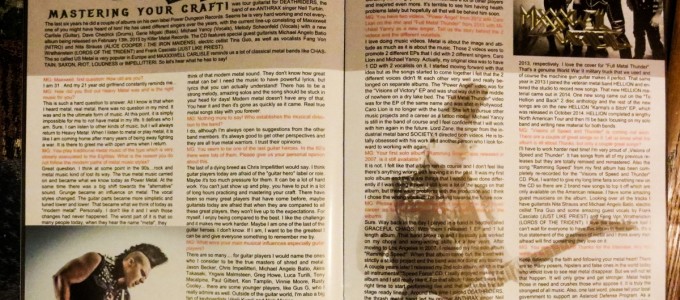
metalgods-mag2The latest issue of Germany’s Metal Gods Magazine has published a 2 page featured interview with Max. The interview covers a variety of subjects including the Maxxxwell Carlisle live band, the latest full-length release “Visions of Speed and Thunder”, playing in HELLION and upcoming projects. Max also gives his opinion on the “guitar hero” label and why so many guitarist avoid it. Other topics like the value of music videos, working with guest musicians and the influence of Grunge on the current music scene, are also covered.

Click image below.


IMG_3436


BraveWords Reviews “Visions of Speed and Thunder”

MaxxxwellCarlisleVisionsOfSpeedAndThunderMetal news giants BraveWords have reviewed Maxxxwell’s latest full-length album, “Visions of Speed and Thunder”.

Fist-pumping, American heavy metal is what you’ll get from mohawk-sporting bodybuilder guitarist Maxxxwell Carlisle…As you can imagine, the guitar skills from every player here is exceptional…If headbangable, straight-ahead metal songs is what you crave, then Visions Of Speed And Thunder will more than do the trick.

Click here for the full review.


LA Metal Media Posts Coverage of Hellion’s Jam Night Appearance

max-bjorn-luckystrikeLA Metal Media has posted a gallery of photos by Roc Boyum featuring HELLION performing at the Lucky Strike Ultimate Jam Night, Wednesday October 14th, 2015.

Click Here for full gallery.


HELLION performs at Lucky Strike Ultimate Jam Night

Wednesday, October 15th 2015, HELLION performed a cover of “The Green Manalishi (With the Two Prong Crown)” and their classic hit “Stormrider”, at the Lucky Strike Jam Night in Hollywood. Ann Boleyn on vocals, Scott Warren on keyboards, Maxxxwell Carlisle and Ira Black on guitars, Bjorn Englen on bass and Simon Wright on drums. A HELLION live album is slated for release later this year.


The Musician’s Fear of Finishing

through-the-eyes3-sizedMusicians have no shortage of big plans. From 2 hour concept albums to mind blowing stage productions that would put Cirque du Soleil to shame, we often have an unrivaled ability to dream up things we’d like to accomplish…someday…as soon as we finish that press kit and play that Monday night show at the Viper Room. We’re going to blow the mind of each and every one of those 25 people who we begged to come out. But we need to be ready, so it’s cool that we’ve been rehearsing for 8 months to perfect our 30 minute set. Of course we’re on our 3rd bass player now… those first 2 guys just had a bad attitude, you know, wanting to be paid and everything. Anyway, we’ll be ready in a couple more months, probably. Although we might need a new in-ear monitor rig, but once we get that dealt with, for sure we’ll be ready… Does this sound familiar?

I’m sure you know or have known people who just can’t finish things. Let’s look at a more specific example. I won’t mention names, but I’ve got a particular lead singer in my mind. Who it is doesn’t really matter, you just have to know that he is real and he was once the lead vocalist of one of the top veteran metal bands. The band was and still is a household name in the world of metal. This singer was part of the band’s humble beginnings appearing on their debut album. His contributions were considerable but for various reasons that are not important now, he parted ways with the group very early on. That was 30 years ago, and after exiting that band, his artistic output quickly sank to nothing. Despite this, his former band’s subsequent accomplishments and rise to fame was enough to keep his name coming up in conversation, generally with speculations of “what if” he hadn’t left so early. Fast forward to today and we find that for the past 8 years (at least), he has been working steadily on his current band’s debut album. Debut album. This band has been around for at least 10 years. Let that sink in. There is plenty of material for a full length album, modest interest from labels and promoters, interest from fans, and yet the album is never quiet done. It always needs one more mixing session or re-do, one more mastering engineer, or one more new song to really finish it off. Over the years, there have been countless news headlines about how the album is almost done and coming out soon. These headlines repeat themselves every 6 to 12 months, with the album’s name changing every couple years. When pressed on the album’s lack of…a deadline or perhaps existence, our mystery lead singer will say things like, “we’ll we’re taking our time to make sure it’s done right”, or “I don’t want to cut corners and cheat the fans”. “Doing it for the fans” always makes a good fallback position. The bottom line here is that the album has been 6 months away from being finished since it was started. I’m not singling out one person here (or lead singers in general), but that story makes a great example. We have all known people like this. They have songs, but they’re never quite ready to record. Or they have songs recorded but the mix is never finished. Maybe they’re students, and they got to the last class but got to their final exam and then backed out. So close, but never finished. Why does this happen?

Simply put, this kind of “anti-finishing” behavior comes from the paralyzing fear of final judgment and rejection. If we never finish, we can always think that success and achievement is just around the corner. For artistic types like musicians, the fear of our work being deemed unworthy runs deep. We are defined by what we create. When our work is judged to be poor or underwhelming we take it as a direct reflection of who we are. What if those haters were right? What if those moments of self-doubt were more justified than we had hoped? For many, the possibility of facing that judgment is simply too much. Too much of a risk. Better to live in a world with the possibility of success than one with the certainty of failure. That is of course, a very short sighted view. These fears lead to crippling self-sabotage, mental paralysis and (let’s cut to the chase here) the pissing away of opportunity and sometimes even entire lives. In the case of this unnamed singer, his lack of creative output over the decades has made his current situation even worse. He’s comparing his new work to the work he did as a young man 30 years ago. He is no doubt a very different person with very different abilities now than he was and had then. In a genre that puts so much emphasis on technical skill and physical appearance, this situation doubles down on the pressure that he’ll put on himself. It’s no excuse though. The only way out of this situation is to finish what you start.

The lessons and knowledge we learn from our failures is priceless. As the late IBM CEO Thomas Watson Sr. put it, “the fastest way to succeed is to double your rate of failure”. Rising up from the ashes of previous failures is how we build quality and precision into our future work. There is a clarity of vision and perspective that can only be achieved through hindsight. Get that song recorded. Get that album out. Send the press-kit to the promoter. Do your best, but then let it go and let it be judged. Your audience will tell you what works and what doesn’t. From that reaction and from your own feelings 6 months down the road, you will learn and grow. As artists our work evolves, gaining quality and precision as we move forward. The process can only work if we can finish things and then move on to the next.

There is of course a fine line between never having the confidence to finish something and rolling something out before you’ve done your fair share of work. Personally, I tend to err on the side of overconfidence. In retrospect, my first solo album (no longer available), was not a quality product. The production was dubious at best, the songwriting was self-indulgent (did “Victory Foretold” really need five verses?) and even the cover was phoned in. However, I could only fully realize the seriousness of those issues after I released it and saw and heard the reaction of the audience. I learned from the experience, and it pushed me to work much harder on my 2nd album, which I’m still happy with to this day.

just-get-it-doneAlthough I’ve used one particular person as an example, I hope I’ve made it clear that this problem is one that affects a huge number of people, musicians and artists of various types in particular. Some of us never start, but so many more start but never finish. Imagine looking back on your life after having spent decades making excuses as to why something wasn’t finished, only to wonder where the time went and how it was possible for you to accomplish so little. Somewhere along the line you got stuck and couldn’t finish what you started. Let’s not fall into this trap. Just get it done.

– Max Carlisle


String Dampeners: Crutch, or Weapon of Choice?

Atmax-dampener what point does an aid become a crutch, and how do we make that distinction? In the world of music production, the line between helpful tool and straight up studio magic is hard to draw. Auto-tune would be an obvious example. At first it was a subtle polishing effect to perfect an already strong vocal line. As time went on, we relied on the effect more and more until a “oh don’t worry about it, we’ll fix it with auto-tune” attitude developed. With today’s mentality towards music production, we’ve ended up with some singers who have never been heard without some kind of auto-tune or other pitch correcting effect. This isn’t just limited to pop stars and hip-hop artists, it has even leeched into our scene through the polarizing Metalcore genre. And yes, now we can auto-tune guitar too. There are those who will say that in the studio, anything goes. Do whatever you need to get the sound you want. But what about live? How true to the recording does the live performance have to be? We can’t all be Manowar and bring the Czech Phil-harmonic on the road with us. So samples are ok? What about drum samples? Vocals? Guitar harmonies? And what about guitar effects? Should the player be running everything, creating his own sounds, or is it OK that the guitar tech is operating the Wah pedal from off stage? Let’s not even get into Quantization. Do these devices and methods illustrate a continuing trend towards musical laziness or simply the gradual symbiotic evolution of musicianship and the industry that it supports? These debates go on and on, but today I’d like to look at one device in particular that comes up again and again in the world of shred guitar, the String Dampener.

WHAT ARE STRING DAMPENERS?

String dampeners are simply devices which mute open strings. They drastically cut down on unwanted string noise and feedback, ebass-mutespecially in high gain environments. There are essentially 4 major designs. The first design includes variations on a simple mechanical system built into the guitar itself, typically by the bridge. These are commonly used in genres such as Bluegrass or slap-bass technique where a muted sound is preferred most of the time. These designs use felt or rubber to press against the strings near the bridge and in some cases can be turned off and on, but often are permanently active.

The second design would be an electronic pickup system like the one found in the Moog Guitar which uses strong electromagnetic fields to limit movement of the strings. It’s the same idea as sustainer pickups, but in reverse. One rather nit-picky complaint of high-output pickups is that the larger magnets typically employed can kill sustain. Amped-up electromagnets take that to the next level, effectively muting the strings. This has a mixed bag of pros and cons. You have the convenient ability to activate or deactivate the muting with the push of a button, and since the entire system is built into the guitar’s electronics, it won’t change the aesthetics of the instrument (we’re picky about that aren’t we?). On the down side, the muting system effects every note, not just open strings. If you’re shredding non-stop, all day, every day, that’s fine but any slower playing is out of the question. And lets not forget that all this takes some very specialized electronics. Not easy or cheap to add to your existing rig.

Next up we havegreghowe-carvin sleeves and inserts. These are basic wraps or inserts which go around the neck or between the fretboard and the strings to limit string movement. These are of course the simplest and cheapest and are made by a variety of companies. Dirty socks tied around your neck fall into this category. Typically the player will move these around the neck as they play, to fine tune the amount of muting, or simply get them out of the way of their fretting hand. A few examples of players who use this style of dampener would be Guthrie Govan, funk master Victor Wooten, Andy James and neoclassical and fusion virtuoso Greg Howe . Greg is an especially noteworthy example thanks to him always color coordinating his dampener to his guitar. Props Greg. We notice things like that.

In our forth and final category we have mechanical add-on devices that mount on the guitar’s headstock. These typically employ a hinged mechanism to press a material, such as felt, onto the the strings usually between the nut and the 1st fret. The muting material can be lifted up out of the way should you need to play open chords or otherwise not want the muting effect. These offer the advantage of being able to be added to almost any guitar and can be “turned off and on” quickly and completely, something you can’t really do with wraps. Price wise they come in slightly more expensive than wraps or inserts but still much less than a bridge mounted device or electronic system. Classic examples of this would be the Michael Angelo Batio or Jennifer Batten dampeners. The main difference between the Batio and Batten designs are in how they attach, clamped or screwed on, respectively.


WHEN DO WE USE STRING DAMPENERS?

For average licks and standard-issue blues based guitar techniques, dampeners don’t make much difference one way or the other. Between palm muting and the unused fingers of your fretting hand, you’ve got your strings covered, literally. There are however, a number of techniques and musical situations that don’t lend themselves to traditional styles of muting. Let’s look at a few of them:

  1. Hammer-ons From Nowhere: This technique, popularized by neoclassical and fusion virtuoso Greg Howe, requires tapping or hammering-on a note with your fretting hand, as the first note of a line. Typically it will combine tapped notes from both hands, often alternating. The increased strength and speed that you need on your fretting hand generally requires that you increase the “striking distance” of your finger, coming in at the string from a higher “altitude”. This increased distance from the strings makes it much more difficult and sometimes impossible to do any substantial muting with your fretting hand. When both hands are tapping, you encounter the same issue, at the same time, with your picking hand. In a case like this a string dampener makes a world of difference, essentially providing a 3rd hand to take care of muting.
  2. Over-the-Neck Playing: A flashy and perhaps under-utilized technique developed by players like Akira Takasaki, David Shankle, Michael Angel Batio and Mike Orlando, this technique has both of your hands coming over the neck instead of your picking hand over and your fretting hand under. This creates an unfortunate circumstance when trying to mute the higher (musically higher) strings. Both takasakihands are pointing the same direction and if you’re playing, let’s say on the D string, there’s nothing to cover the G, B and E strings. Mr. Takasaki is unique in this situation in that he has developed a way of using his little finger as a sort of “bar dampener” to mute the strings in some arpeggiated runs. For most scalar lines though, the problem remains. This technique is another that benefits greatly from the application of a string dampener.
  3. Tap/Slap Only and Djent Style Playing: For some musical styles you simply don’t want a lot of notes ringing out together. Tapped double-stops common to fusion bass lines and Djent style guitar need a very fast note release with an equally fast decay. These styles require a percussive kind of sound and again, the string dampener helps substantially in this regard.
  4. Playing more than one instrument simultaneously: OK, let’s be honest, not many people do this, but if you’re playing guitar and your picking hand is busy doing something else (playing a 2nd guitar in Michael Angelo Batio’s case, or yo-yoing in Jason Becker’s), then you’re left with not much other choice than to use a string dampener to control muting.


ARE THERE RIGHT OR WRONG WAYS TO USE A DAMPENER?

The aforementioned situations are cases in which there is a fully legitimate need for additional muting, which the string dampener provides. But as I’m sure most of you know, the most common use of string dampeners is to simply ‘clean up’ regular solos on studio recordings. This is more of a gray area and where we get into the ‘ethics’ of string dampeners. Often they’ll be used in the studio but they won’t be used live for the rather petty reason that guitarists can expect a certain level of shit-talking from other guitarists, usually with their arms crossed over their Fates Warning t-shirts (like Dream Theater but before being like Dream Theater was cool). The typical argument is that we’re simply trying to replace a well practiced proper muting technique, and that by relying on a string dampener, it becomes a crutch and lets us take the easy way out. It’s fair to say that in a real-world live show, no one is going to notice a 10% change in the cleanliness of your playing. Between the live energy, the booze, the questionable house mix and the bassist spilling his beer on the kick-drum mic, there’s simply too much going on for differences of that amount to stand out. It’s a safe and easy choice to leave the string dampener that you used in the studio, at home. But is that the right choice? And are we making it for the right reasons?

Consider this: Are we taking the easy way out when we play a guitar with a thinner neck profile and better fret access? What about light gauge strings? They are easier to bend after all. What about bigger frets? Picks that are easier to hold? Or how about a guitar that just weighs less? Again, is that the easy way out? Or just preference? Different players will give different answers to those questions, and you will have to come up with your own, but somehow I doubt that you’re going to say that playing a comfortable guitar is cheating. We pick and choose our equipment so that we can consistently create and perform at our best. How about we look at it from a more artist perspective… Let’s say we use the dampener in the studio but then choose to not use it live. In that situation, an argument could be made that we’re giving a less authentic and deliberately less accurate performance. Like using a clean electric guitar to play an acoustic part. If that’s the case, wouldn’t it be better to use it consistently as a regular part of your setup? It certainly seems more honest than having it kept as a “secret” studio tool. And as for the dampener haters, how are they different from the guys who say that you only use a tuner because you’re too lazy to tune by ear. Few players would take that statement seriously.

I agree with those who say that it’s sometimes a good idea to make things a little hard on yourself when you’re practicing. Rehearsing songs while standing up and walking around as apposed to sitting down with a perfectly positioned footrest for instance, or practicing in the dark or at least in dim, stage-like lighting. This kind of worst case scenario preparation can go a long way when you’re starting a tour or debuting a new song. At some point though the practicing stops and the performance begins. That’s the time when we should give ourselves every advantage, be it live or in the studio. When you go into battle, you don’t take your knife and leave the canons at home. You take every available weapon and march forth with hopes of conquering your enemies and hearing the lamentation of their women. As guitar design and the technology around it continues to evolve, who are we to pass over the sharpest weapons of our time?

– Max Carlisle


New Merch Super-Paks available now…

3CD-super-pack+picksSeveral new merch bundles have been added to the Webstore.

CDs, an 8×10 photo, stickers and guitar picks for one low price! Ships worldwide!


“Ramming Speed” lyric video released for Visions of Speed and Thunder album.

rammingspeed-vidFrom the “Visions of Speed and Thunder” album comes this completely re-recorded version of “Ramming Speed”, originally released on the debut Maxxxwell Carlisle solo album of the same name. Featuring Frank Casciato on lead vocals, the lyric video features the photography work of Les Dishman, Michele Beck and Al Valdez.

“Visions of Speed and Thunder” is released on Killer Metal Records and is available worldwide as of February 21st, 2015. The full length album features selected tracks from each of Carlisle’s previous releases, remixed and remastered, as well as brand new tracks, both vocal and instrumental. The album features performances by Michael Angelo Batio, Fang VonWrathenstein, Tina Guo, Nita Strauss and more!


“Visions of Speed and Thunder” is available HERE from Amazon.com Mp3.

The album is also available on iTunes and in physical CD form from the Webstore.

European customers can order direct from Killer Metal Records in Germany.